
Picasso in Montmartre: From Childhood to Genius
Table of Contents
Youth in Spain
Before age 10 (1881–1891): Málaga
From ages 10 to 14 (1891–1895) : La Corogne
From ages 14 to 19 (1895–1900): Barcelona / Horta de Ebro / Madrid
The Parisian Takeoff, Picasso in Montmartre
From ages 19 to 20 (1900–1901): Promising Beginnings
The 1900 World’s Fair
The Ambroise Vollard Exhibition
From ages 20 to 23 (1901–1904): The Blue Period
From ages 23 to 25 (1904–1906): The Rose Period
The Bateau-Lavoir
Gertrude Stein
From ages 25 to 33 (1906–1914): Cubism
Les Demoiselles d’Avignon
A Four-Way Construction
A Style in Evolution
The End of His Montmartre Years
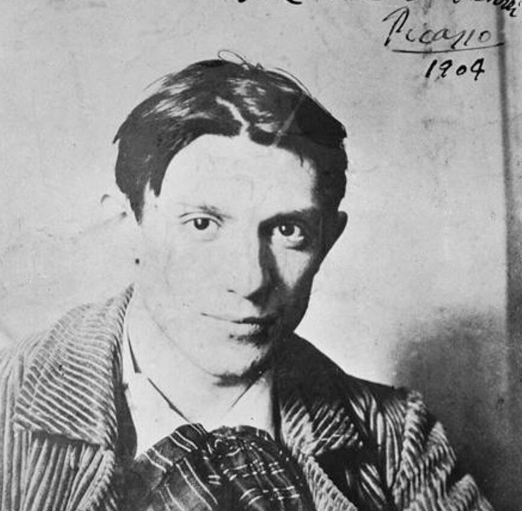
Youth in Spain
Before age 10 (1881–1891): Málaga
Picasso is born in Málaga, on the southern coast of Spain, in 1881.
His father, Don José Ruiz Blasco, is an artist who is particularly fond of painting pigeons. He earns a living from a few sales, but mainly by teaching drawing and working at the local museum.
His mother is Doña María Picasso López. Pablo has two sisters, Lola (short for Dolores) and Conchita (short for Concepción). In 1883, his grandmother and two aunts move in with the family after financial difficulties caused by the destruction of their vineyards by phylloxera. As the cherished eldest son, loved by his mother and adored by his sisters, young Picasso grows up surrounded by women.
Very early on, he follows in his father’s footsteps and begins drawing. Little interested in school, he sketches everything he sees.
Don José strongly influences Picasso during his early years, both in his choice of subjects, such as pigeons, and in his interest in bullfighting. A passionate aficionado, he takes Pablo to bullfights from a very young age. This becomes the subject of Picasso’s first oil painting, completed at the age of eight: The Little Picador.
From ages 10 to 14 (1891–1895): La Corogne
Financial difficulties lead Don José Ruiz Blasco to accept a position in La Corogne, a city in northwestern Spain.
While the climate and lack of familiar surroundings plunge his father into melancholy, young Pablo is stimulated by the atmosphere and produces a great many sketches. His precocity and speed of execution are such that his pigeons soon become indistinguishable from those painted by his father.
In 1895, his sister Conchita dies of illness. That same year, his father is accepted at the prestigious Barcelona academy, La Lonja, and he enrolls Pablo there as well. The entrance exam, which consists of presenting a completed work, usually takes a month.
Picasso finishes it in one day, later saying that he cannot see what needs to be changed.
From ages 14 to 19 (1895–1900): Barcelona / Horta de Ebro / Madrid
At fourteen, five to six years younger than his classmates, Picasso is nonetheless the most gifted among them. He absorbs all the styles of the great masters of the past. Don José then seeks to move his son to a new level and encourages him to produce his first official painting, First Communion. His father even poses as a model, and young Pablo signs the work “Pablo Ruiz Picasso.”
His father’s influence can be seen in his early works, which are marked by a classical, academic approach. Science and Charity, his second monumental work, also clearly belongs to this tradition of large salon painting. It likewise carries a biographical dimension, linked to the death of his sister Conchita.
In 1897, at the age of sixteen, he leaves for Madrid, to free himself somewhat from his father’s supervision, and enrolls at the Royal Academy. He spends much time at the Prado Museum studying the masters.
Invited by a painter friend, Manuel Pallarès, he stays in the village of Horta de Ebro to recover from an illness. For Pablo, this is a return to the land and to simple tasks; he feels at ease there and stays for nine months.
Back in Barcelona in 1899, the young painter is now independent and shares a studio with his friend Carlos Casagemas. In search of new experiences, Pablo lives a bohemian life with a group of former fine arts students. He moves away from academic style and immerses himself in the effervescence of Barcelona.
In particular, he frequents a bar-cabaret popular with many artists, Els Quatre Gats (“The Four Cats”). The name comes from a humorous expression suggesting that there are not even four people present (spanish expression meaning, “not a soul”).
Already recognized for his talent, Picasso holds his first exhibition there in 1900, filling the room mainly with portraits, unframed works in charcoal, pencil, or watercolor, along with a few oil paintings.
The Parisian Takeoff, Picasso in Montmartre
From ages 19 to 20 (1900–1901): Promising Beginnings
The 1900 World’s Fair
In 1900, Pablo is invited to present a work, The Last Moments, at the World’s Fair held in Paris. Accompanied by Carlos Casagemas, the experience is a shock for both artists.
Fifty million visitors crowd into the capital; the banks of the Seine are covered with hundreds of national pavilions, and people circulate on moving walkways. The city’s first subway line is inaugurated, as are the Petit Palais and the Grand Palais, where major artists such as Rodin, Cézanne, and Renoir are exhibited.
Pablo Picasso is deeply shaken by the sight of these masterpieces and, from then on, never stops wanting to equal them.
Casagemas and Picasso settle in Montmartre in a studio at 49 rue Gabrielle, where they join a community of impoverished Spanish artists. Pablo is noticed by the art dealer Pedro Mañach, who offers him a contract. For the salary of a laborer, 150 francs a month, Picasso must provide paintings on demand. It is a godsend for the young painter, who is short of money.
The two friends throw themselves headfirst into the festive and turbulent life of Montmartre at the beginning of the twentieth century. Carlos falls madly in love with a model, Germaine Gargallo, who prefers other men, notably the charming Picasso. Casagemas sinks into despair and alcoholism and finally takes his own life in early 1901, shooting himself in public at the Café de l’Hippodrome.
While visiting Barcelona, Pablo learns the news upon his return but does not dwell on it for long. His agent, Pedro Mañach, has just secured him an exhibition with Ambroise Vollard. At the time, this is a famous gallery where major names such as Renoir and Cézanne have already been shown.
The Ambroise Vollard Exhibition
Pablo throws himself completely into work. In one month, he must produce around sixty works. The paintings of the nineteen-year-old artist are bright and luminous, inspired by painters such as Van Gogh and Toulouse-Lautrec. Picasso’s self-portrait, Yo, Picasso, greets visitors.
From that day on, he no longer signs his works Pablo Ruiz Picasso, but simply Picasso, now his artist’s name, and further distances his painting from that of his father, José Ruiz Blasco.
The exhibition is a success. Picasso sells paintings, and his name also becomes known. Press articles begin to nickname him “the little Goya.”
From ages 20 to 23 (1901–1904): The Blue Period
Six months later, at the age of twenty, the image of his dead friend comes back to haunt him, and he paints Casagemas dead, with the bullet wound visible at his temple. He reveals this work only fifty years later.
This period marks the beginning of a major change in his painting. He no longer dwells on the anecdotal or the picturesque, but seeks truth in human nature through sadness and melancholy. He looks for it in the faces of the destitute.
He visits a women’s prison hospital to draw inspiration from the women treated there, most of whom are prostitutes. Themes such as poverty, old age, and death become his new subjects.
The colors he uses are predominantly blue, with shades of green and gray.
This period is anti-commercial, with very few sales and a life of poverty. Pedro Mañach no longer understands his protégé and drops him. After living in a studio at 130 boulevard de Clichy until early 1902, Picasso lives mainly in Barcelona with the help of friends and family before returning to settle more permanently in Paris in May 1904.
From ages 23 to 25 (1904–1906): The Rose Period
The Bateau-Lavoir
In May 1904, accompanied by a painter friend, Sebastià Junyer Vidal, and his dog, Picasso moves into the Bateau-Lavoir. The place is unsanitary and is known at the time as “the trappers’ house,” a cheap lodging where about fifteen Spanish artists live. The building has only one water tap and a shared toilet. While his friend stays only one month, Picasso remains there until 1909, in the studio on the upper floor.
Very quickly, Picasso meets his neighbor Fernande Olivier, known as “the beautiful Fernande.” An artist’s model his age, she captivates him, and Picasso falls madly in love with her. Around the couple, a circle of friends forms, including Max Jacob and Guillaume Apollinaire.
At this time, Picasso rediscovers the joy of life of his early Parisian years. He frequents the Lapin Agile cabaret, at 22 rue des Saules, as well as the Cirque Médrano on boulevard de Rochechouart.
His color palette shifts toward warmer tones, with pinks, ochers, and oranges. He paints intimate scenes, moments of calm and rest, and the circus—with its performers and acrobats—quickly becomes a central theme.
Gertrude Stein
In the fall of 1905, an American woman knocks on the door of the Bateau-Lavoir. Gertrude Stein is a wealthy heiress who hosts an influential artistic salon, in her Left Bank apartment, at 27 rue de Fleurus. She holds many receptions there, inviting avant-garde artists and potential buyers.
Having seen one of Pablo’s works in a shop, she wants to meet him in person and crosses Paris with her brother Leo to visit the Bateau-Lavoir.
A larger-than-life character, she makes a strong impression on the painter and buys about ten works for 800 francs, a fortune for Pablo. From that point on, Picasso will no longer faces financial difficulties.
Later, he offers to paint her portrait, a proposal she accepts, traveling across Paris to pose for the young painter. However, Pablo struggles to complete the work. This period is also one of questioning: photography is becoming widespread, and Picasso searches for a new way to approach painting.
The turning point is said to occur in 1906, while he is on vacation with Fernande in the village of Gósol, in the Spanish Pyrenees. There, he finds new inspiration in volume, simple forms, and an archaic statue in the village church.
Upon his return, after nearly ninety sittings, Picasso finishes the portrait of Gertrude Stein. It takes on a geometric, pared-down appearance, with a mask-like face. This painting marks the beginnings of a new style that will profoundly transform Western art.
When Stein remarks that it does not look much like her, Picasso replies, “You will end up looking like it.” The portrait quickly becomes a major piece in her collection, which she donates only after her death.
During this period, Picasso also confronts another major figure: Henri Matisse. About ten years his senior, Matisse is considered the leading avant-garde painter of the moment.
His vividly colored works, such as Woman with a Hat (1905), earn him the nickname “fauve,” giving rise to the movement later called Fauvism.
From ages 25 to 33 (1906–1914): Cubism
Les Demoiselles d’Avignon
Picasso takes this rivalry personally. He wants to do better; he wants to go further.
Around this time, in 1905, he works on the painting that marks the beginning of the movement now known as Cubism: Les Demoiselles d’Avignon. Influenced by a return to so-called primitive art and by Paul Cézanne’s work on form and segmentation, the painting depicts five prostitutes from Avinyó Street in Barcelona.
It is not exhibited until years later, in 1916, but it already causes a stir within Picasso’s private circle.
This is especially true for the artist who becomes Picasso’s counterpart in the adventure of this new style: Georges Braque. He is the first to publicly exhibit this style with his painting Large Nude in 1908 at the Salon des Indépendants.
A Four-Way Construction
Pablo and Georges are subsequently shown in the private collections of a man who seeks to compete with Ambroise Vollard in the exhibition and sale of art in Paris: Daniel-Henry Kahnweiler.
Newly arrived from Germany and the son of a wealthy family, he is not initially destined to become an art dealer. He decides to settle in Paris and open an art gallery at 28 rue Vignon. He becomes Picasso’s main dealer, particularly abroad, in Russia and the United States. At the same time, their friend, the poet Guillaume Apollinaire, becomes their most ardent defender in the press.
The roles are defined: Picasso and Braque create, Apollinaire defends, and Kahnweiler sells.
A Style in Evolution
Pablo Picasso fully commits himself to the prolific construction of his work. What follows is a shared adventure in which Picasso and Braque respond to each other, constantly trying to push their creation further.
Three major phases can be seen in the evolution of their work over time: first, a geometrization of forms between 1908 and 1909; then a deconstruction between 1909 and 1911; and finally, between 1912 and 1914, a reconstruction.
Henri Matisse describes these paintings as being made of “little cubes,” and the term Cubism follows. Picasso always denies this label.
In 1909, Pablo and Fernande move to a large apartment at 11 boulevard de Clichy. Picasso nevertheless chooses to keep his studio at the Bateau-Lavoir in order to stay in contact with his friends.
This move up the social ladder results from the success of his sales through his friend Daniel-Henry Kahnweiler, the high pricing of his work, and especially the support of a Russian collector, Sergei Ivanovich Shchukin.
The end of his Montmartre years
In 1912, his relationship with Fernande grows distant, and Pablo begins a relationship with Eva Gouel. They have been friends for several years; Eva has until then been the companion of one of Picasso’s friends, Louis Marcoussis.
They become a couple shortly after their respective breakups and move to the south of Paris.
Picasso is only 31 years old...
Step into Montmartre and follow the streets where Picasso lives and creates, while you enjoy an unforgettable chocolates and pastries walking tour.

Comments